
Practical bakery buying guide
How to compare wholesale bakery quotes
The lowest price per piece is not always the lowest cost for the order you actually need. Put each bakery quote on the same basis before choosing a supplier: the same product format, usable quantity, receiving arrangement and service requirements.
First, make sure you are comparing the same requirement
Send each supplier the same brief. Specify the product or acceptable alternatives, the number of usable servings, the required date and where the order will be received. A quotation for a whole cake cannot be compared directly with a quotation for individual cake portions without agreeing the serving size and who will portion it.
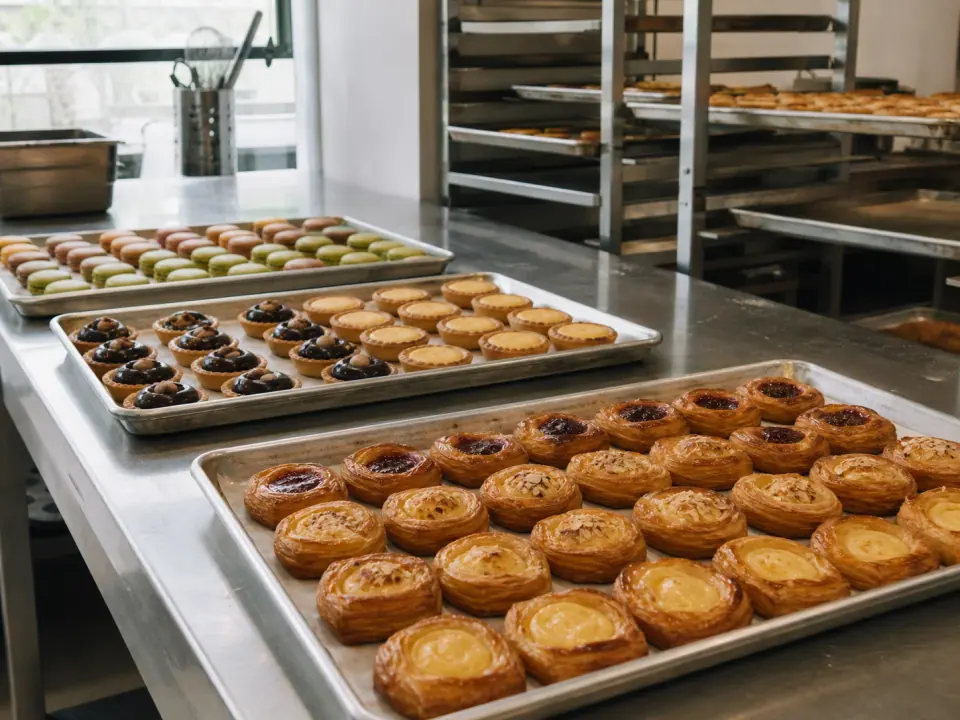
Record the product dimensions or portion description, pieces per pack and any minimum quantity. Also establish whether products arrive ready to serve or need finishing. Photos can help identify a format, but they do not establish its size, packing or preparation requirements.
Separate minimum order quantity (MOQ) from minimum order value. One controls the number of units or packs you must purchase; the other concerns the total spend. Ask whether a minimum applies per product, per flavour or to the complete order. This distinction matters when you want a varied café range in modest quantities.
- Product and portion specification
- Number of usable portions required
- Pack size and minimum order
- Delivery or collection arrangement
- Any preparation or equipment needed before service
Compare the total payable cost, then the usable portions
Use this calculation: product subtotal + packing charges + delivery or collection costs + other applicable charges and taxes = total payable. Confirm what is already included so you do not add a charge twice. Compare all quotes on the same tax basis; an unclear total is a question to resolve before choosing.
For a one-off order, divide the total by the portions you expect to use. For recurring café supply, also consider whether surplus units can realistically be sold within the supplier’s product-specific handling instructions. Buying more is useful only when those extra units have a clear role.
The example below assumes you need 80 portions, all products meet the same specification and the listed costs are complete before any applicable tax. All amounts are illustrative Singapore dollars (S$), not The Cake Factory prices or ordering terms.
| Item | Quote A | Quote B |
|---|---|---|
| Quantity purchased | 100 portions | 80 portions |
| Price per purchased portion | $1.80 | $2.40 |
| Product subtotal | $180 | $192 |
| Delivery | $30 | $12 |
| Total before applicable tax | $210 | $204 |
| Cost per required portion | $2.63 | $2.55 |
Account for the work your team still has to do
Quote B costs $6 less in that example even though its headline unit price is higher. Quote A supplies 20 additional portions, which could be useful or unnecessary depending on the service plan. The comparison does not decide quality, suitability or value on its own.
Check the receiving window, storage space, finishing work, display equipment, portioning and packaging disposal. Assign an internal cost only when you have a defensible estimate. Otherwise record the task and who will own it; an invented labour saving makes the comparison less useful.
Test whether a larger order is worth the surplus
If a lower price requires a bigger pack or order, show what happens to the extra units. For a one-off event, unused portions may have no planned role. For a café, there may be another service opportunity, but only if expected demand and the product-specific instructions support it. Do not count possible future sales as certain.
In the earlier illustration, Quote A costs S$210 and supplies 100 portions. If you genuinely use all 100, the cost is S$2.10 per used portion. If only the required 80 are used, it is S$2.625, rounded to S$2.63. Both calculations are correct; they answer different questions about how the order is used.
Write down the assumption behind your chosen denominator. Then compare a realistic lower-demand case as well as your expected case. A cheaper headline unit price can still be sensible, but the decision should survive a clear explanation of the surplus, not depend on treating it as automatically valuable.
Keep product suitability separate from price scoring
Before ranking quotes, identify requirements that must be confirmed: the usable portion format, food information, preparation requirements and receiving arrangement. Mark each as confirmed, unsuitable or awaiting clarification. A numerical average should not allow a low price to cancel out an essential requirement that is unmet.
Where products differ, describe the difference plainly. A ready-to-serve portion and a product needing additional preparation are not identical offers. Neither is automatically better; compare them against your equipment, staff and service plan. If a quotation uses an alternative product, obtain the revised specification and cost before treating the comparison as complete.
| Decision field | Supplier A | Supplier B |
|---|---|---|
| Exact product and serving specification | Record confirmed details | Record confirmed details |
| Packs, minimums and purchased quantity | Record confirmed details | Record confirmed details |
| Total cost on the same basis | Enter quoted inclusions and charges | Enter quoted inclusions and charges |
| Expected portions used and surplus | State your assumption | State your assumption |
| Essential requirements | Confirmed / unsuitable / awaiting answer | Confirmed / unsuitable / awaiting answer |
| Quote validity and change terms | Record dates and agreed process | Record dates and agreed process |
| Decision and unresolved questions | Name owner and next step | Name owner and next step |
Resolve the terms that can change the order
Ask how long the quotation remains valid, when quantities must be final and what happens if an item becomes unavailable. Record the process for substitutions, changes, cancellations, damaged items and short deliveries. Do not assume the terms of a previous supplier apply to the new quotation.
For regular supply, separate a trial order from the ongoing arrangement. Agree what the trial should establish: product fit, receiving process, handling effort and customer response. A single successful order does not by itself confirm every future delivery window or volume.
Keep the quote reference and date with your comparison. If quantities, products or fulfilment change, ask for an updated total and check that its validity still covers your decision date. Comparing an old price for one scope with a new price for another can create a misleading saving.
Use a short comparison sheet for the final decision
Put confirmed facts in one column and unresolved questions in another. Mark each supplier as suitable, unsuitable or awaiting clarification for requirements that are essential. A supplier who cannot meet the agreed serving or receiving requirements should not win simply because their price is lower.
When contacting The Cake Factory, share your required products or serving format, quantity, date and delivery or collection questions. Ask for the details needed to compare your specific brief. Our team will confirm what can be offered before an order is agreed.
- Requirement and specification match
- Total payable and usable portions
- Team handling and receiving responsibilities
- Confirmed order terms
- Outstanding questions and decision date